
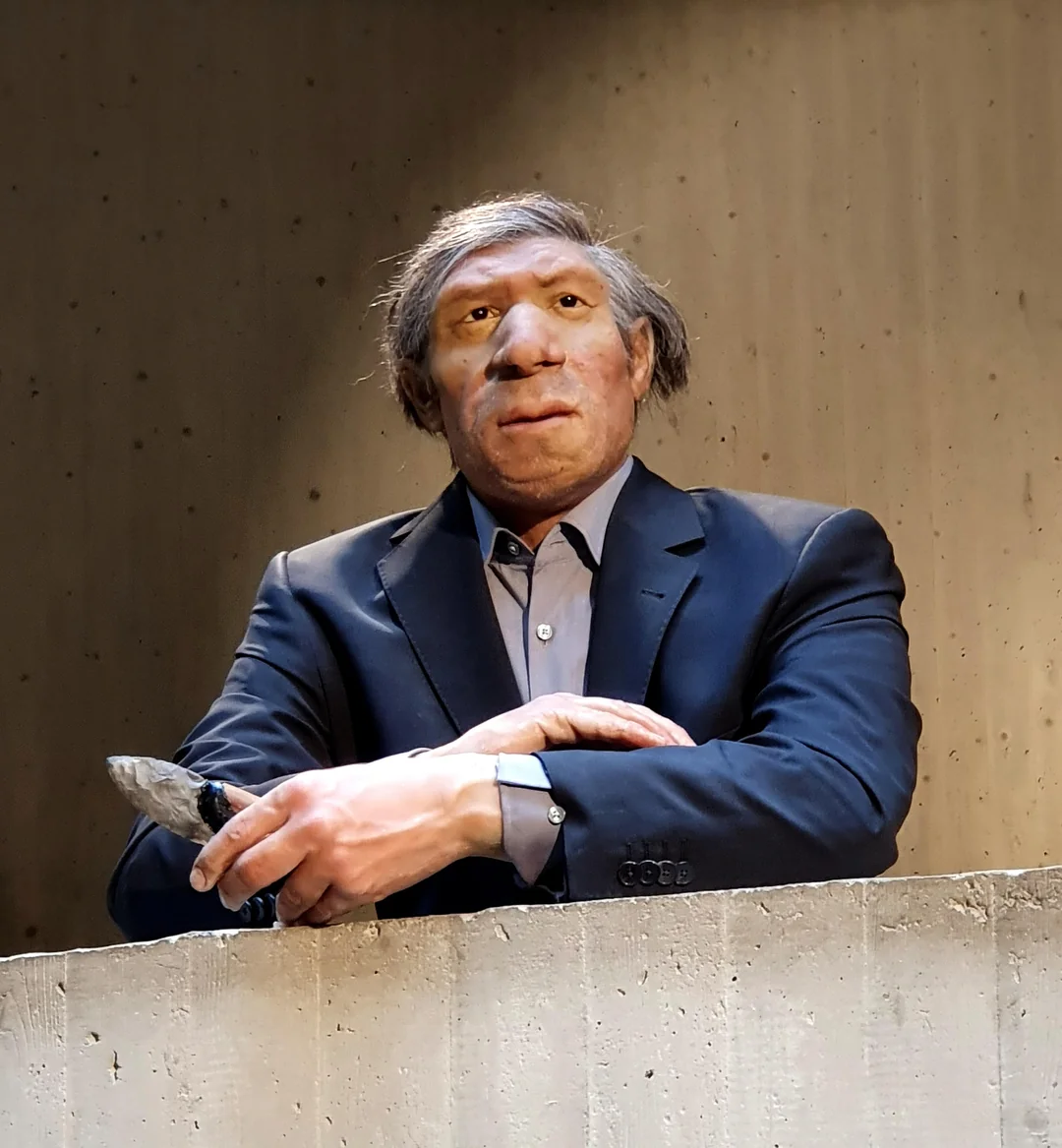
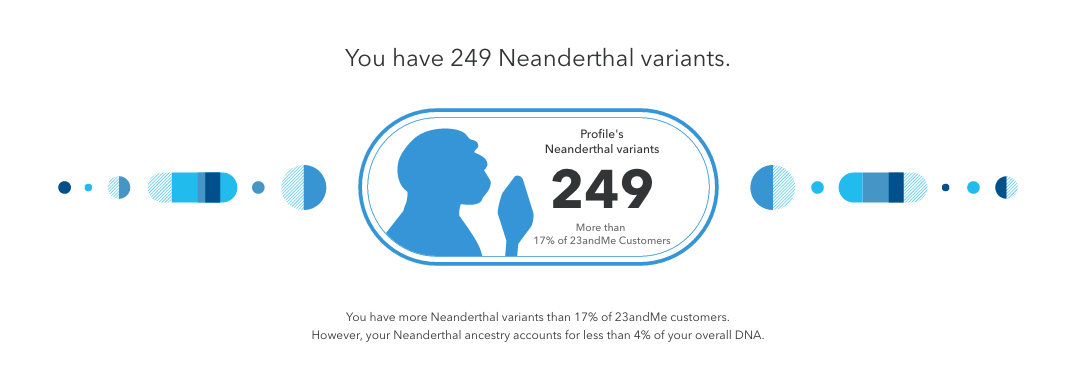
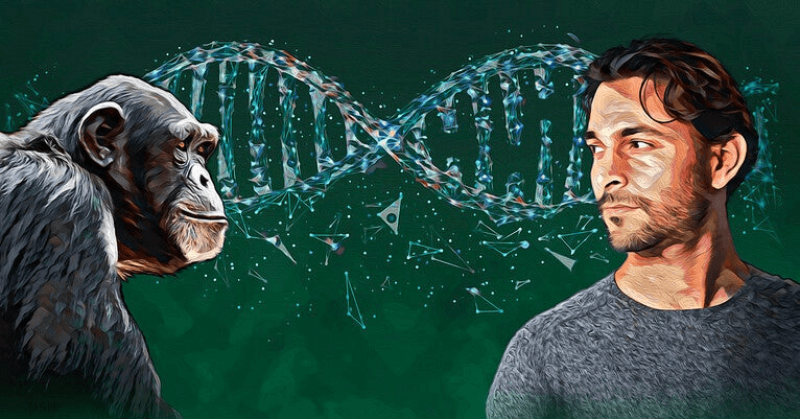
You carry DNA from an extinct species. This isn't speculation or fringe science—it's one of the most thoroughly established findings in modern genetics. If you have any ancestry outside sub-Saharan Africa, between one and four percent of your genome came from Neanderthals. Some populations carry even more from another group called Denisovans.
Most people, when they learn this, treat it as a curiosity. Consumer DNA tests report your "Neanderthal percentage" alongside your ancestry composition, and people share their results on social media like a quirky badge. "I'm 2.7% Neanderthal—that explains a lot!" It makes for good conversation at parties.
But if you take your faith seriously, this finding should stop you cold. Because it means that somewhere in your ancestry, your forebears interbred with creatures who were not—by any meaningful theological definition—made in the image of God.
The Discovery That Changed Everything
In 2010, a team led by Swedish biologist Svante Pääbo at the Max Planck Institute published the sequenced Neanderthal genome. It was one of the most significant papers in the history of anthropology. For the first time, scientists could directly compare the genetic code of modern humans with that of an extinct human-like species.
What they found was explosive. Non-African humans share significantly more genetic material with Neanderthals than Africans do. The only explanation that fits the data is interbreeding. Our ancestors, after migrating out of Africa, encountered Neanderthals in Europe and the Middle East—and had children with them. Those children survived, reproduced, and passed Neanderthal DNA down through the generations to us.
This wasn't a tentative finding or a controversial interpretation. Within a few years, the scientific community had reached consensus. Study after study confirmed it. Ancient DNA recovered from human fossils tens of thousands of years old showed the same Neanderthal signatures we carry today. The interbreeding was real, it was extensive, and its genetic legacy is permanent.
Not Just Neanderthals
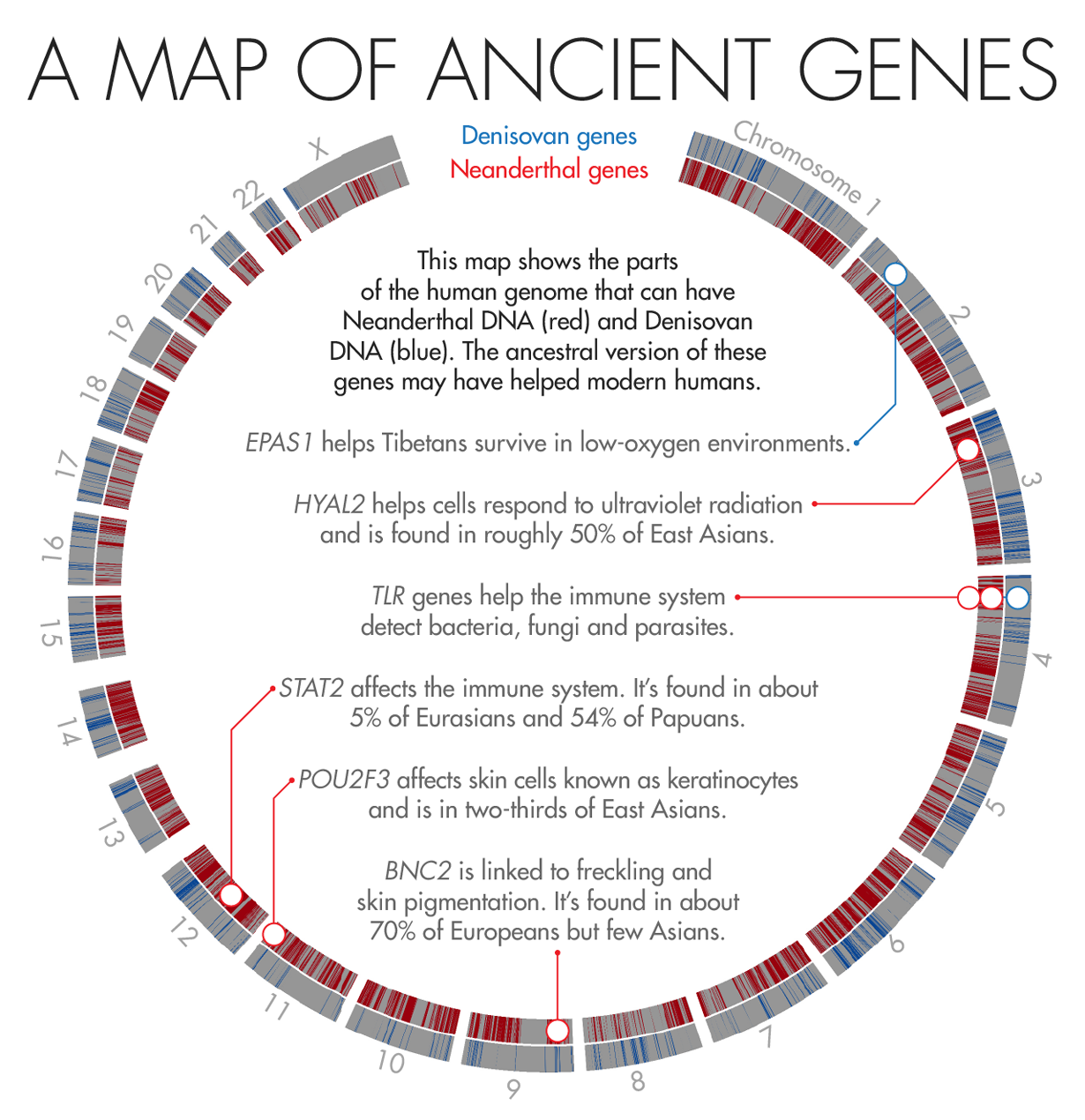
Neanderthals weren't the only ones. In 2010, the same year as the Neanderthal genome publication, researchers announced the discovery of the Denisovans—an entirely new group of ancient humans identified from a single finger bone found in a Siberian cave. We have almost no fossils from them. But we have their DNA. And that DNA shows up in modern humans too.
Melanesian populations—the people of Papua New Guinea and nearby islands—carry as much as four to six percent Denisovan DNA. Some East Asian and Southeast Asian populations also carry smaller amounts. Like the Neanderthal contribution, this came from ancient interbreeding events.
And there's more. Geneticists have detected signatures in modern human DNA from what they call "ghost populations"—ancient groups we haven't yet identified from fossils but whose genetic fingerprints remain in living people. Some African populations carry DNA from unknown archaic humans. Even Neanderthal DNA contains traces of yet another unidentified group. The more we look, the more mixing we find.
"Around 50,000 years ago, the world was populated by multiple groups of human-like creatures—Homo sapiens, Neanderthals, Denisovans, possibly others. They encountered each other. And they interbred."
What This DNA Does
Not all Neanderthal DNA stuck around. Natural selection has been slowly removing it from our genomes over the millennia. The parts that remain are not randomly distributed.
Some Neanderthal DNA appears to have been beneficial. Genes related to immune function, for example, often show Neanderthal variants—our ancestors may have picked up useful adaptations for fighting European and Asian pathogens. Some genes affecting skin and hair also retain Neanderthal contributions.
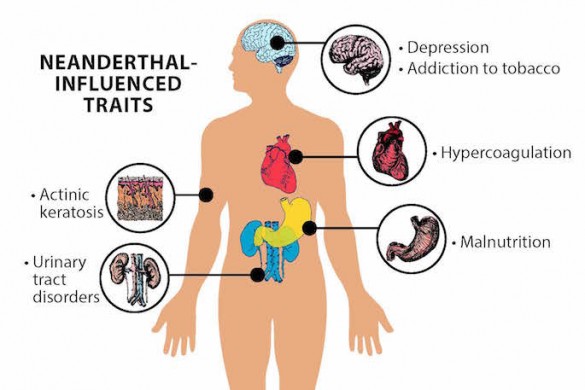
But here's what's striking: the regions of the genome most depleted of Neanderthal DNA are those related to the brain. The genes that govern cognition, language, and the neural structures that make us distinctly human—these are almost entirely free of Neanderthal contribution. Natural selection has been especially aggressive about removing Neanderthal variants from the parts of us that think and speak and reason.
What should we make of that? From a purely evolutionary perspective, it suggests that Neanderthal brain-related genes were somehow incompatible with modern human cognition—that mixing in this area was harmful and was therefore eliminated. But from a theological perspective, one might ask: were these the genes most connected to whatever makes us image-bearers? Was there something about the Neanderthal mind that was fundamentally different from ours—and that our genomes have been trying to purge ever since?
Why This Matters for People of Faith
If you don't take Scripture seriously, none of this is particularly troubling. Evolution happened, species mixed, here we are. It's interesting biology, nothing more.
But if you believe that humans are uniquely made in God's image—that we possess something no animal possesses, a spiritual capacity that sets us apart from all other creatures—then the presence of Neanderthal DNA in your genome demands an explanation.
Were Neanderthals also made in God's image? If so, what does that mean? The traditional understanding is that the image of God is tied to Adam—to a specific creative act, a specific moment when God breathed life into humanity. If Neanderthals share that image, then either Adam lived hundreds of thousands of years ago (which strains the biblical chronology), or the image of God is something far more diffuse than we've understood.
Or were Neanderthals not made in God's image? Were they sophisticated, tool-using, perhaps even language-using animals—but animals nonetheless, lacking whatever spark makes humans human? If so, then our ancestors bred with animals. And we carry the evidence of that in our DNA.
Neither option is comfortable.
The Christian response to this evidence has been, frankly, inadequate. Young-earth creationists typically argue that Neanderthals were just humans—descendants of Adam scattered after Babel. This sidesteps the problem but creates others. Old-earth creationists at organizations like Reasons to Believe have struggled to reconcile their models with the interbreeding evidence, initially denying it and now trying to work around it. Most believers simply don't know about the findings at all.
But ignoring the evidence won't make it go away. It's in peer-reviewed journals. It's in consumer DNA tests. It's in you.

"…the historicity of Adam (is) crucial for hamartiology, or the doctrine of sin. For if Adam was not a historical person, clearly there was no historical fall into sin…and no sin of Adam that can be imputed to every human being…and we cannot be held guilty."
What the Churches Actually Teach
This isn't a fringe concern or an academic abstraction. The doctrine of original sin—rooted in a historical Adam whose transgression corrupted all his descendants—stands at the foundation of Christian theology across every major tradition. Remove Adam, and the entire structure begins to collapse.
Consider what the churches officially confess:
"Through the temptation of Satan man transgressed the command of God, and fell from his original innocence whereby his posterity inherit a nature and an environment inclined toward sin."
"The whole human race is in Adam 'as one body of one man.' By this 'unity of the human race' all men are implicated in Adam's sin... Adam had received original holiness and justice not for himself alone, but for all human nature."
"The covenant being made with Adam, not only for himself, but for his posterity; all mankind, descending from him by ordinary generation, sinned in him, and fell with him, in his first transgression."
"Since the fall of Adam all men who are propagated according to nature are born in sin... without fear of God, without trust in God, and are concupiscent. And this disease or vice of origin is truly sin."
"Original sin... is the corruption of the nature of every man, that naturally is engendered of the offspring of Adam, whereby man is very far gone from original righteousness, and of his own nature inclined to evil."
"Through Adam's sin all of mankind has fallen and inherited a sin nature, thus man in his natural state is lost, alienated from God and incapable of attaining salvation by any personal effort."
Catholic and Protestant. Mainline and evangelical. Calvinist and Arminian. Liturgical and Pentecostal. On almost nothing else do these traditions agree so completely. Yet on this they speak with one voice: Adam was real. His sin was real. And something passed from him to us—something that explains why we are the way we are, why we need a Savior, why Christ had to come.
Now consider what science tells us: something did pass from ancient ancestors to us. It's called DNA. And one to four percent of it came from creatures who were not Adam's descendants—who, by any theological definition, could not have been made in God's image.
These two facts cannot both be ignored. Either the churches are wrong about Adam, or science is wrong about Neanderthals, or there's something we haven't understood about what actually happened in Eden.
Where We're Going
Over the next eight posts, I'm going to propose an answer. It's not the traditional answer. It will make some readers uncomfortable. But I believe it takes both Scripture and science seriously—and it may be closer to what actually happened than the Sunday school version we grew up with.
We're going to ask whether Neanderthals were truly human in the theological sense, or something else. We're going to look at what Scripture actually says about the boundaries between kinds of creatures—and what ancient texts like the Book of Enoch say about what happens when those boundaries are crossed. We're going to examine the doctrine of original sin and ask how a spiritual corruption could be inherited biologically. And we're going to return to the Garden of Eden and read the story of the Fall with fresh eyes.
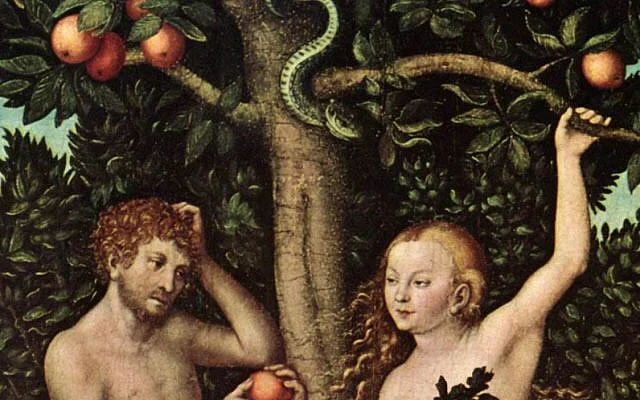
What if the "forbidden fruit" was never about fruit at all? What if the first sin wasn't eating from a tree, but crossing a boundary that was never meant to be crossed—a boundary between image-bearers and those who, for all their sophistication, were not?
What if the corruption we call "original sin" isn't a metaphor or a mystery—but is literally encoded in our DNA, a permanent record of what our ancestors did?
The science is settled. The theology is not. It's time we brought them together.